
Bonjour mes amis!
Welcome back to another blog! Its that time again where I try to explain very interesting concepts that I have learned about in an academic way…but ultimately end up confusing all of us and turning everything into one big internet meme! 😀
However I will try to be more professional this week as today’s topic requires a little more sensibility and attention. What is that topic you ask? Digital literacy!
In the most basic sense, as most of us know, the most simple definition of being “literate” is having the ability to read and write, or having basic use of language. However a more theoretical definition might be that “Acquiring literacy does not involve memorizing sentences, words or syllables … but rather an attitude of creation and re-creation, a self-transformation producing a stance of intervention in one’s context.” (Paulo Freire, Education: The Practice of Freedom (1973) )
While these are both wonderful explanations of linguistic literacy, today we are going to discuss digital literacy. What is is, who is literate, and does it have any real standing in today’s society.
Now, I vould attempt to explain digital literacy in my own words, but I honestly believe it would be confusing and probably take me all day, so to give credit to some experts (who actually undertsand all this) I shall give you this definition;
Digital literacy is;
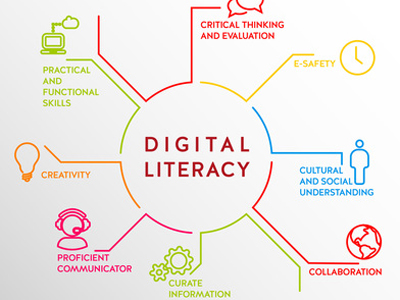
Cognitive, emotional and social competencies that include:
- the use of texts, tools and technologies
- the skills of critical thinking and analysis
- the practice of message composition and creativity
- the ability to engage in reflection and ethical thinking
- active participation through teamwork and collaboration.
From: Digital and Media Literacy: A plan of action. (Hobbs, 2011)
I short, being digitally literate not only means be able to use the basic functions of technology and digital tools such as websites, social medias and other digital tools, but also being able to use their advanced features, and use them for your own unique purposes. A very simple example of this would be having the ability to use all the advanced design functions of this website to create your own blog!
So, does that make me a so-called digital native? Or am I what is known as a digital immigrant? Well according to Prensky (2001) I am a digital native,a s I was born into a time that was full of new and wonderful technology and has full use of these tools throughout my life (We didn’t have our first smartphones however until I was about 12!) My father on the other hand, would be considered a digital immigrant, as he was born in the 1970s, long before many of the current technological wonders have surfaced. (The man still can’t use Facebook bless him.)
How does this affect digital literacy? Are all digital natives inclined to be more,iterate than immigrants? Or is our ability subject to the time and effort we put into learning and familiarising ourselves with technology? (Benini, 2013)
What do you all think? Let me know your thoughts in the comments. Are you a native or an immigrant? Does it matter at all? I’d love to hear your thoughts!
Until next time!
Amee x

 Amee's Language Babbles